Africa often brings to mind images of poverty, tribal life, malnutrition, and child deaths due to epidemics. Yet, the continent is blessed with extraordinary natural beauty. Its numerous national parks and forest reserves attract tourists from across the world. Among these, the Maasai Mara Game Reserve is regarded as one of Africa’s greatest wildlife sanctuaries. Covering nearly 200 square miles of open plains, woodlands, and riverine forests—and contiguous with the Serengeti—the Mara hosts a breathtaking diversity of wildlife. It is located just five-hours drive from Nairobi, the capital of Kenya.
The landscape is not densely forested, allowing visitors to easily observe wildlife in their natural habitat. The vast grasslands are dotted with herds of zebra, giraffe, gazelle, and topi. Elephants and buffaloes wallow in the wide Musiara Swamp. The Mara and Talek rivers are filled with hippos and crocodiles. Leopards rest on isolated trees and can often be spotted from a distance. In the soft, warm light of early morning, a variety of animals emerge to bask in the sunshine. Watching large prides of lions roaming freely is truly thrilling.
For Indian travelers, the months of May and June are ideal for visiting the Maasai Mara. During this period, tourists from Europe and the USA are fewer, making the trip more affordable. The rainy season ends around this time, turning the landscape lush and green—perfect for wildlife photography.
Instead of the usual vacations to Singapore, Malaysia, or Europe, exploring national parks like the Maasai Mara can be a refreshing and enriching experience. I visited the Maasai Mara twice in 2011 and wish to share my experiences, so that you too feel inspired to witness this majestic environment. You can also include a visit to Lake Nakuru along with the Maasai Mara trip. I stayed at Sarova Resort, run by an Indian proprietor, Mr. Vora. They serve excellent Indian cuisine and provide comfortable hospitality. After a long day of wildlife viewing, entertainment at the resort ensures you remain engaged even after sunset.
Around 3 p.m., we visited the lake, just 10 minutes away. I was stunned to see thousands of lesser and greater flamingos, great white pelicans, grey herons, African open-billed storks, saddle-billed storks, marabou storks, yellow-billed storks, African spoonbills, sacred ibis, white-faced whistling ducks, Egyptian geese, red-billed teals, secretary birds, long-crested eagles, crowned cranes—countless species gathered together.
It felt magical, like a dream come alive. Groups of hippopotamuses swam leisurely, reminding us of the lurking danger in the waters. The next morning, we headed into the forest near the lake and spotted hook-lipped black rhinoceroses, square-lipped white rhinoceroses, waterbucks, greater kudus, Beisa oryx, roan antelopes, impalas, red-tailed guenons, Angola black-and-white colobus monkeys, and African wild buffaloes. It is impossible to do justice to this diversity by merely naming them—you must see them in person. After lunch, we left for the Maasai Mara, completed the entry formalities, and began a trek reminiscent of scenes from National Geographic or Discovery Channel. As we progressed, we encountered different species of wild animals, amazed by their colours, movements, and group dynamics.
We photographed enthusiastically, unsure of what to capture and what to leave. As we ventured deeper, the number of deer and giraffes decreased, and we found ourselves standing before a magnificent lion sitting on a rock, surveying the horizon like a true king. When he noticed us, he walked toward our vehicle, followed by a dozen lionesses and cubs.
I felt an intense, indescribable moment as he stared straight into my eyes. I was mesmerized, unable to look away or even click a picture. His majestic presence, fearless expression, and powerful aura held me captive. For a moment, I felt an urge to touch his thick mane, but I was frozen with awe. It was an unforgettable encounter—something words can never fully capture.
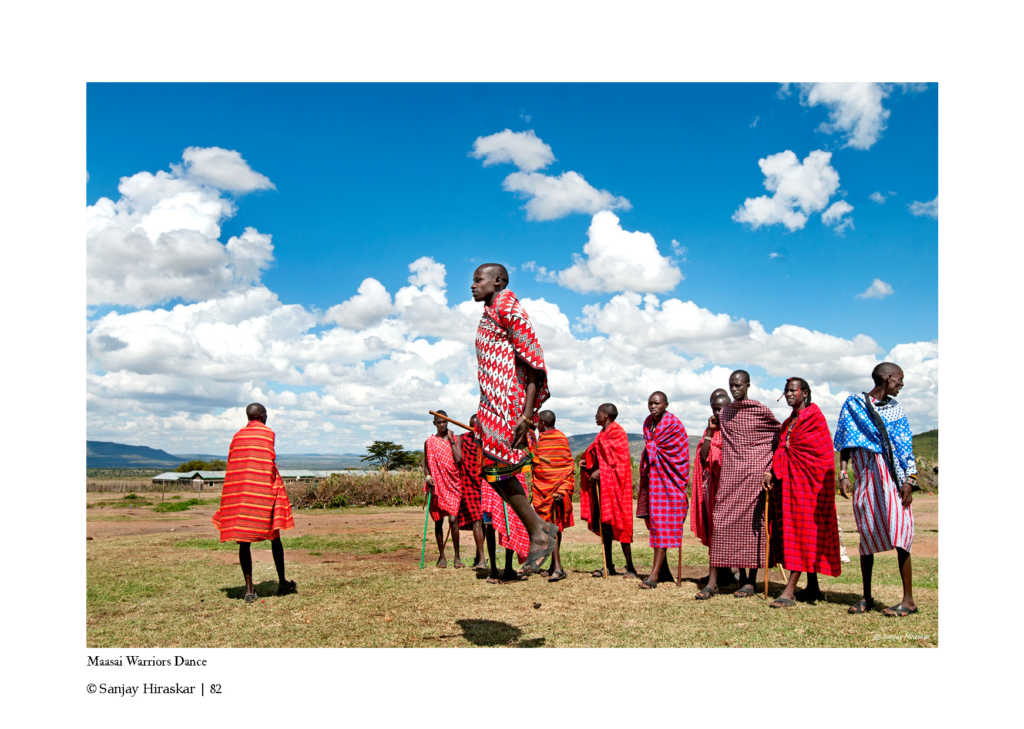
As dusk approached, I captured a beautiful sunset photograph: a topi deer silhouetted against the golden sky, framed by an acacia tree. The composition was perfect—no shadows, no clouds, just pure natural beauty. Back at the resort, we were given hot water bags to ease the fatigue from the day’s trek. After a refreshing hot shower, I joined other tourists at the dining hall, where everyone shared their wildlife experiences. The Maasai dance performance at night added to the charm, transporting us into a world of culture and celebration. Before sleeping, I transferred all my photos to my laptop and charged my equipment for the next day.
On the third morning, our guide drove us quickly to a bush and asked us to remain silent. There, a family of cheetahs was resting. The cheetah, known as the fastest animal in the world—capable of reaching 80 km/h—can be identified by the distinctive black tear lines running from its eyes to its mouth. When the male stood up, I was struck by his powerful legs and the graceful curve of his body. He seemed more approachable and gentler compared to lions.
We spent four memorable days in the Maasai Mara. On the fourth day, we visited a Maasai village to photograph the community. We paid $20 per person for permission to take their pictures. One man dressed in traditional warrior attire posed for us, though modern influences were visible—watches, jeans, and other accessories—which we requested him to remove for an authentic portrayal.
On our last evening, we witnessed a dramatic hunt. A pride of lions was eyeing a herd of zebras. John warned us that their focused gaze indicated an impending chase. A lioness suddenly charged toward the herd, followed by two lions flanking her and others spreading out strategically. The herd scattered instantly. The lions targeted a single zebra, and within seconds, it was surrounded and brought down. I captured the moment when a lion leaped onto its back and bit its neck in the final strike. The cubs watched intently, learning the art of hunting. The male lion observed from a distance, ready to intervene if needed. Witnessing a live kill was both thrilling and unsettling—the rawness of nature, the inevitability of survival. The scene, with blood oozing and the jungle law unfolding before us, will stay with me forever.